Blood Flow Restriction Training: Guide & Training Plan
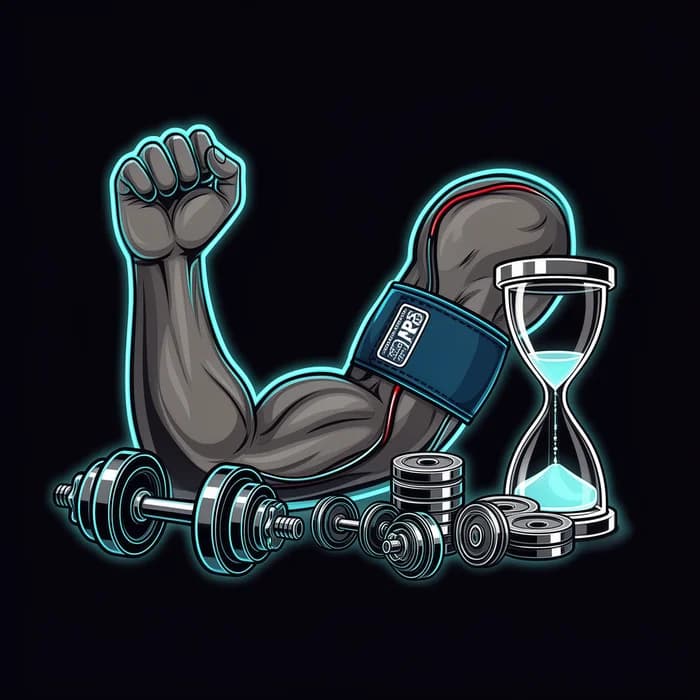
Blood Flow Restriction Training: More Muscle Growth with Less Weight
Do you want to boost your muscle growth without necessarily lifting heavier weights? Then Blood Flow Restriction (BFR) training is just right for you. This innovative training method allows you to train with only a quarter of your maximum strength and still achieve impressive results. In this article, you will learn everything important about BFR training, its pros and cons, as well as suitable training plans for beginners and advanced users.
What is Blood Flow Restriction Training?
In BFR training, blood flow in the muscle is specifically restricted to create an intense pump. The goal is to inhibit venous return while maintaining arterial blood supply. This results in more blood accumulating in the muscle, thus improving nutrient transport. This effect can be achieved with special wraps or bandages that are applied before training.
How Does BFR Training Work?
To achieve the desired effect, you need to restrict your muscle—but not too tightly! The arteries supply oxygen- and nutrient-rich blood to the muscle, while the veins carry away the used blood. If you constrict the muscle too much, you block both vessels, which prevents the desired pump and can even be dangerous. Over time, you will develop a good feel for how tight the bandages need to be to achieve the optimal effect.
Is BFR Training Right for You?
BFR training is suitable for both beginners and advanced users, especially if you want to get back in shape after an injury or simply want to introduce a new training stimulus. Since you work with only about 20-30% of your maximum strength, this method is particularly gentle on the joints and small muscle groups like arms or calves.
Pros and Cons of BFR Training
The advantages of BFR training are obvious: You achieve an intense pump and improve nutrient transport to the muscles while minimizing the risk of injury due to the low weight. However, a disadvantage is that the joints are hardly stressed, which can lead to problems in everyday life if you need to lift heavy objects.
Your BFR Training Plan
A typical BFR set is performed with a weight at which you can manage about 20 repetitions or more. You train until muscle failure and take only short breaks while the muscle remains restricted. This process is repeated for a total of two to three sets. The training plan does not differ significantly from a normal plan, except that you work with less weight and a higher number of repetitions.
Example: BFR Training Plan for Beginners
- Upper Body/Lower Body Split
- 2-3 Sets to Failure
- 15-20 Repetitions per Set
Example: BFR Training Plan for Advanced Users
- Upper Body/Lower Body Split
- 2-3 Sets to Failure
- 15-20 Repetitions per Set
Conclusion
BFR training is an effective method to boost your muscle growth without having to lift heavier weights. It offers a new training stimulus and can help you overcome plateaus. The healthy mix of BFR and normal training is the key to success. Give it a try and find out how best to integrate this technique into your training plan.
Stay focused and disciplined—your muscles will thank you!
Related Articles
Perfect Ab Workout for Men's Physique: The Ultimate Training Plan
Want defined abs? Discover the perfect training and nutrition plan for Men's Physique athletes to build hard abs while maintaining a narrow waist.
Effective Ab Workout: Tips & Exercises for Your Six-Pack
Discover the best tips and exercises for an effective ab workout. Achieve your six-pack goal with targeted training and nutrition.
Perfect Six-Pack Workout Plan for Beginners
Learn how to define your abs with this effective six-pack workout plan and the right nutrition tips.