Coordination Training for Runners: Improve Your Technique
Coordination Training for Runners: Improve Your Technique
As an ambitious runner, you know that it's not just about strength and endurance. A crucial factor is also coordination – the ability to make your muscles work together efficiently and harmoniously. But what exactly is coordination, and why is it so important for running?
Coordination means that your muscles are not only strong but also communicate well with each other. Your brain controls this communication, ensuring that each muscle is activated at the right time and in the right way. Without good coordination, even the strongest musculature cannot work effectively. You might have seen it: a runner with strong legs whose pelvis sways back and forth with every step. This is not only inefficient but also puts unnecessary strain on the back. This is where coordination training comes into play.
The goal of coordination training is to teach your brain to control your muscles optimally. It's about isolating individual parts of the running motion and learning a clean execution through repetitions. This way, your brain can recall these sequences later while running, making you move more elegantly and efficiently.
Another significant benefit of coordination training is injury prevention. Through targeted training, you learn to use your muscles in a way that protects and stabilizes your joints. This significantly reduces the risk of overuse and misalignment injuries.
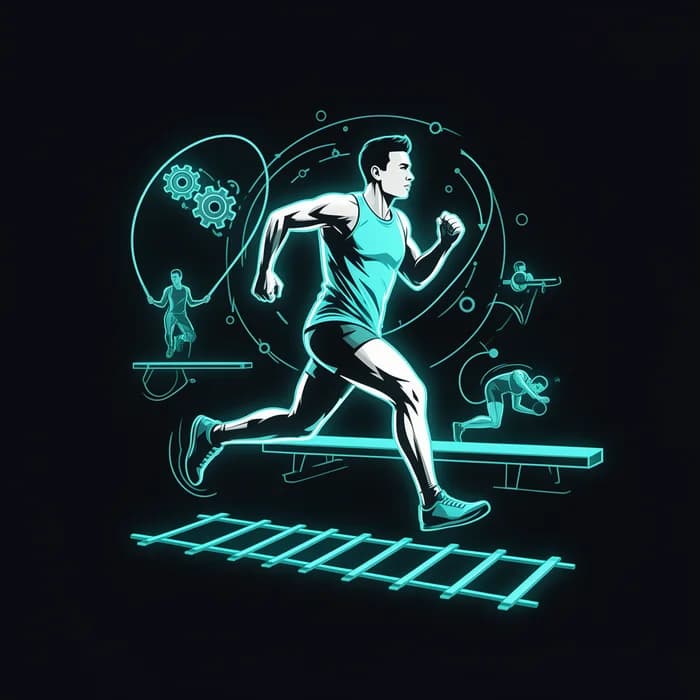
Coordination training can be divided into three groups: balance exercises, strength-based coordination exercises, and isolated movement exercises. Balance exercises train your agility and the connection between nerves and muscles. These exercises are usually focused on the sense of balance and train the small muscles of the lower leg. You can do them with a wobble board or a hot water bottle – as long as the surface is unstable. A simple example is standing on one leg, trying to keep your arms stretched out to the side or upwards. For added difficulty, you can close your eyes.
Strength-based coordination exercises are similar to strength training exercises but with the difference that they are always integrated into the overall movement. An example is jumping rope, where you can switch between different jump variations – from regular jumping to double jumps or crossovers. Another effective exercise is bounding, where you jump forcefully and fully extend during the jump, landing back on the same spot.
Isolated movement exercises, also known as running ABCs, focus on individual parts of the running motion. These exercises should ideally be done barefoot to improve your feel for the movements. Shoes with cushioning can make it harder to perceive these motions and lead to distortion of the exercises. Examples of isolated movement exercises include "hopscotch," where you jump in the air and alternately place your feet apart and together, or "high knees," where you run slowly and try to bend your lower leg as much as possible.
These exercises are not only beneficial for runners but can also help other athletes improve their technique and prevent injuries. By regularly practicing these coordination exercises, you will find that your running technique improves, making you more efficient and injury-free.
Stay committed and enjoy every training session – your journey to the goal begins with each step!
Related Articles
Endurance Training and Muscle Building: Improve Both!
Learn how endurance training can support your muscle building. Tips, training plans, and more for your fitness goal.
Benefits and Basics of Endurance Training for Body & Mind
Discover the benefits of regular endurance training for your health. Learn how to train effectively.
Block Training: Effective Way to Boost Performance
Learn how block training improves your fitness and avoids overtraining. Ideal for endurance and strength athletes.