Proprioceptive training: Exercises & Tips for Beginners
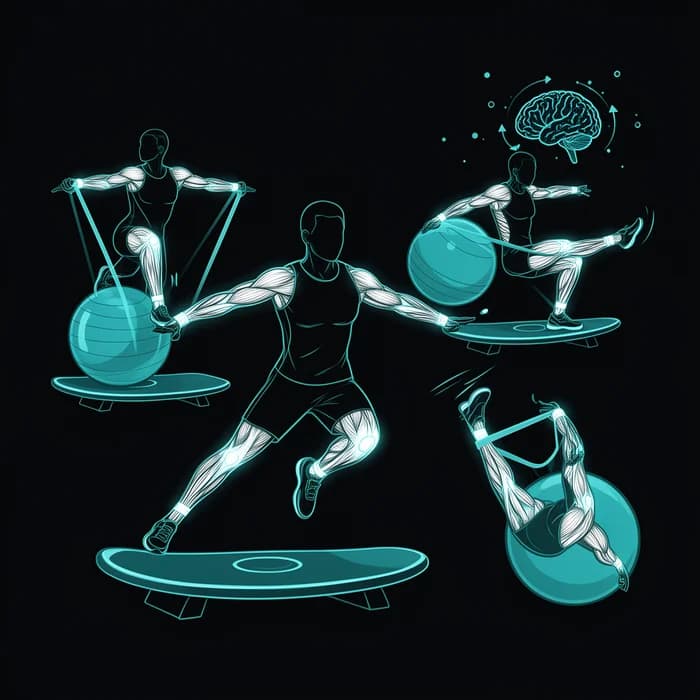
Proprioceptive Training: Exercises & Tips for Beginners
Proprioceptive training is an effective method to strengthen your muscles and prevent injuries. It goes far beyond simple muscle training and focuses on improving mobility, coordination, and responsiveness. In this article, you will learn everything important about proprioceptive training, the benefits it offers, and how you can integrate it into your daily life.
What is Proprioceptive Training?
Proprioceptive training, also known as sensory-motor training, aims to improve mobility and coordination while increasing responsiveness. It is used in many sports and therapeutic applications to restore full mobility and minimize the risk of injury. Unlike conventional muscle training, it not only targets individual muscles but also adjacent muscle groups and joints.
A central aspect of proprioceptive training is working on unstable surfaces such as wobble boards or foam mats. These challenges deliberately throw your body off balance to activate the muscles responsible for stability and coordination.
Benefits of Proprioceptive Training
The training offers numerous benefits, especially for athletes:
- Improvement in Coordination, Mobility, and Stability: Targeted exercises strengthen your body awareness.
- Strengthening Deep Muscles: Especially the spine benefits from strong deep muscles.
- Balance Training: Better balance helps you in everyday life and sports.
- Minimizing Injury Risk: Faster reactions in extreme situations protect you from injuries.
- Promoting Rehabilitation: After an injury, training can help regain original mobility faster.
- Supporting Muscle Interaction: Harmonious interaction of muscles improves your performance.
Who is Proprioceptive Training Suitable For?
In principle, anyone can benefit from proprioceptive training, regardless of age or fitness level. It is particularly useful for people who want to improve their strength, mobility, and speed and prevent injuries. Even in everyday life, the training can help avoid accidents and increase overall physical fitness.
Tools for Proprioceptive Training
There are many tools that can support your training:
- Wobble Boards: These boards tilt forward and backward, challenging your sense of balance.
- Exercise Ball: A classic in the fitness area that forces you to balance every movement.
- Therapy Spinner: Even more unstable than wobble boards and ideal for advanced exercises.
- Foam Mats and Balance Cushions: Unstable surfaces that challenge your coordination.
- Training Equipment: Equipment that engages multiple muscle groups simultaneously.
- Trampoline: Promotes coordination and muscle interaction.
- Resistance Bands and Loop Bands: Perfect for exercises on unstable surfaces.
- Foam Roller: Can also be used for proprioceptive exercises.
Effective Exercises for Proprioceptive Training
Here are some exercises you can incorporate into your training:
- Standing on One Leg: Hold this position for 20 to 30 seconds and try alternating arm extensions or closing your eyes.
- Scale Pose: Stand on one leg, lean your upper body forward, and extend the other leg backward.
- Balancing: Try balancing on a rope or rolled-up towel. Close your eyes for a greater challenge.
- Running in Sand: Jogging on the beach is excellent proprioceptive training as the unstable surface challenges your muscles.
- Planks with One Arm or Leg: Alternately lift one arm or leg off the ground and try to hold the position.
- ABC Running: Incorporate exercises like skipping, high knees, and heel running into your warm-up.
Your Training Plan for Proprioceptive Training
Here is an example training plan that you can do two or more times a week:
- Warm-up with ABC Running (5 minutes): Start with exercises like skipping, high knees, and heel running.
- Planks: Alternately lift one arm or leg off the ground and hold the position.
- Balance on a Towel: Try balancing with your eyes closed or performing a scale pose.
- Push-ups on a Foam Roller: Support yourself with your hands on a foam roller and perform push-ups.
- Squats on an Unstable Surface: Use a foam mat and place a loop band around your thighs for added resistance.
With these exercises and tips, you are well-equipped to start your proprioceptive training and benefit from the numerous advantages. Stay consistent and enjoy the progress in your coordination and mobility!
Aiheeseen liittyvät artikkelit
Kuusipakarat varten Men's Physique -urheille: Äärimmäinen harjoitussuunnitelma
Haluatko määritellyt kuusipakarat? Löydä täydellinen harjoitus- ja ravintosuunnitelma Men's Physique -urheille, jotta saat kovat vatsalihakset ja säilytät kapean vyötärön.
Tehokas vatsalihasvalmennus: Vinkkejä ja harjoituksia sixpackille
Löydä parhaat vinkit ja harjoitukset tehokkaaseen vatsalihasvalmennukseen. Saavuta sixpack-tavoitteesi tarkoituksenmukaisella valmennuksella ja ravinnolla.
Täydellinen alaselkälihasten harjoitusohjelma aloittelijalle
Opi, miten saat näkyvät vatsalihaksesi tämän tehokkaan harjoitusohjelman ja oikeiden ravintosuositusten avulla.